link to go to subject)
 -
Contents
-
ContentsChapter 1. Vision System Design
Chapter
2. Biological Eye Designs
A.
Camera
B.
Pinhole
C.
Concave
mirror
D.
Apposition
E.
Neural
superposition
F.
Refraction
superposition
G.
Reflection
superposition
H.
Parabolic
superposition
I.
Multiple
sensor
types and
combinations of types
Chapter
3. Eye
Design Illustrations
Chapter
4. Eye
Reproduction
Chapter
5. Optical
Systems
Design
Chapter
6. The Eye Designer
Related Links
Appendix
A - Slide Show & Conference Speech by Curt Deckert
Appendix
B - Conference Speech by Curt Deckert
Appendix
C - Comments From Our Readers
Appendix
D - Panicked Evolutionists: The Stephen Meyer Controversy
Chapter 2
Sections G, H and I
-
Prev Page
Go
to Chapter Links
-  Next Page
-
Next Page
- 
(Click on PICTURE IN TEXT to bring up LARGE PICTURE)
2. BIOLOGICAL
EYE DESIGN
G.
Reflecting superposition compound
In a reflection superposition
eye optical
design, a number of reflective, instead of refractive light pipe, lens
elements work together to form an image on a series of image receptors
constructed like a small retina. Here initial optical elements are
reflectors
rather than transmitters like eyeglasses. A small number of the total
reflective
surfaces are used to form each small increment of an image.
| Light is reflected off the sides of small internal facets to focus images on a small group of sensors. Typical creatures with this optical design include some shrimp and crayfish. The optical design is quite similar to other superposition designs. Figure 2.16 illustrates the reflective superposition optical design Figure 2.17 shows an example of reflective superposition eyes. (p. 303, Fig. 3d, Vision Optics Evolution by Dan E. Nilsson, Biosciences, Vol. 39, No. 5, May 1989) | 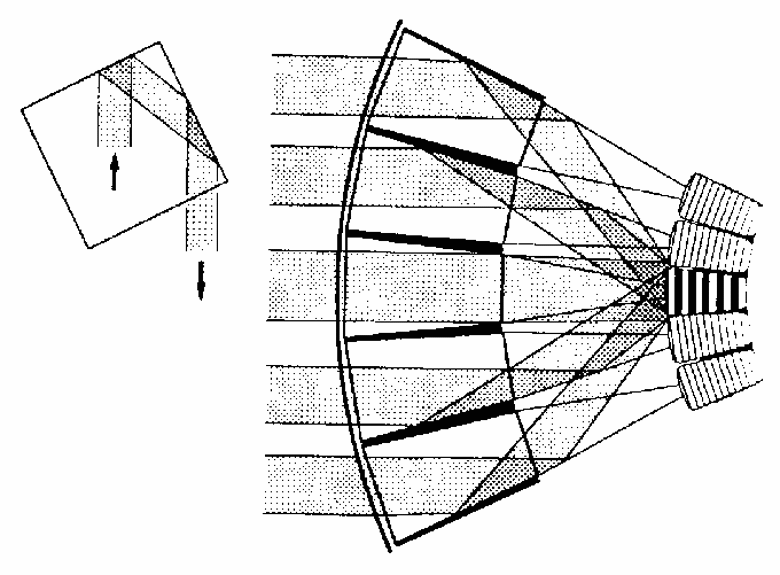
Superposition Optical Design (Like Fig. 6-7) |
| Because of the sharp corners, the internal registration and precision of the reflective surfaces seem to be more critical than previous compound eye designs. This design could work with a wide variety of color combinations, including UV and IR. This optical approach allows design flexibility in creatures where the optical system has more room for a compact retina-type sensor array. Image processing is still difficult to accomplish in the very small volume available for brains in the small creatures using this optical design. (P. 482, Apposition and Superposition Eyess, Peter Kunga, Photochemistry of Vision, Ed. by H. J. A. Dartnall, Sprinzer-Verlag, N. Y., Germany, 1972) | 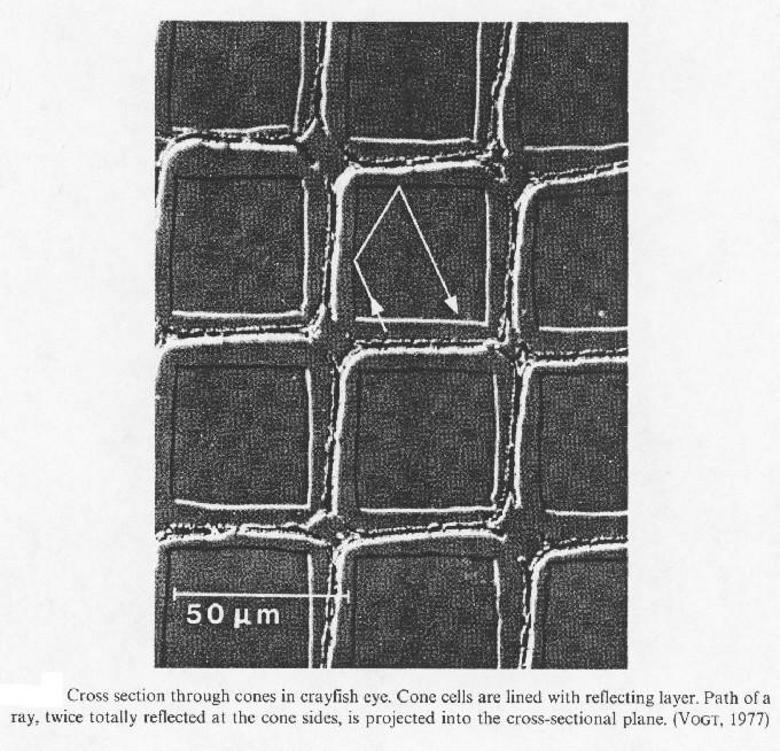
of Reflective-Superposition Eyes of a Crayfish (Cross Section) |
H. Parabolic superposition compound
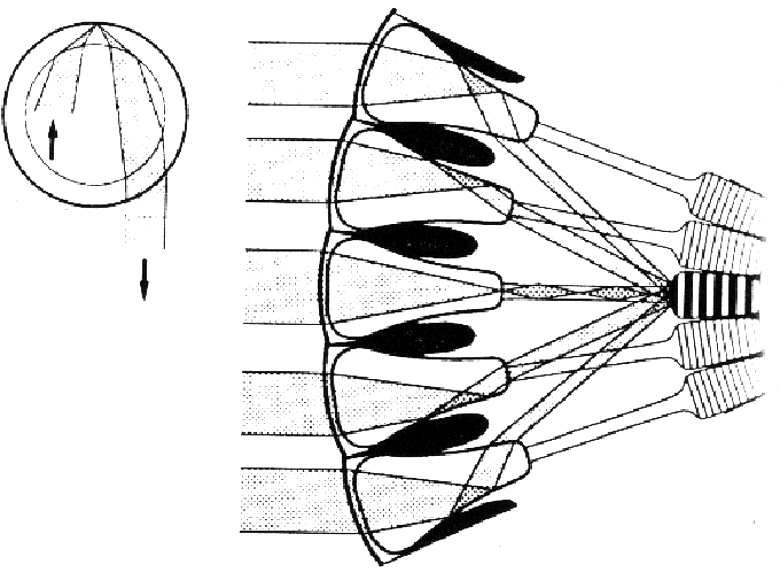
Can one conceive how an array of micro-telescopes originated within crab eyes?

I.
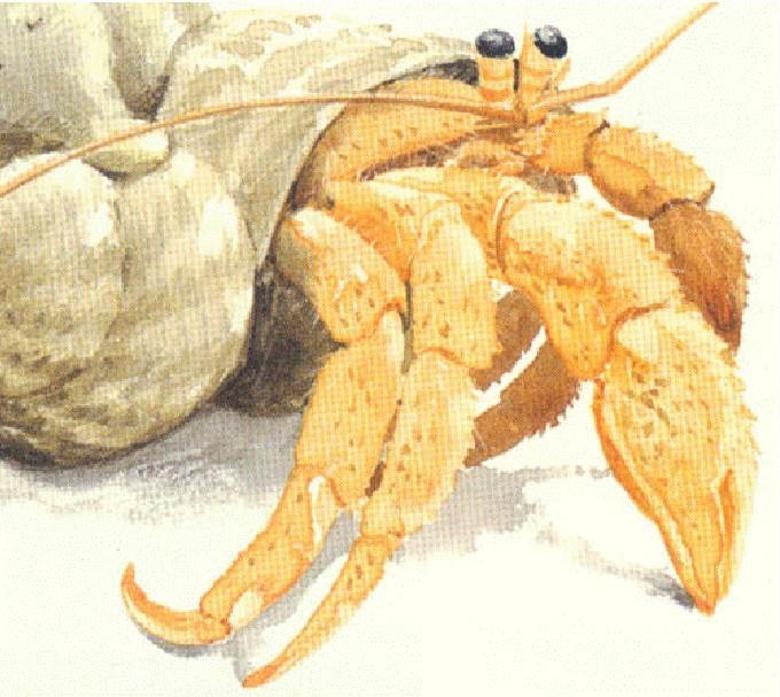
Multiple sensor types and combinations of types
Several animals have specific
receptor eyes
and distributed eyes to supplement their main eyes. This type of vision
occurs in some crabs and shrimp, and in other animals that have several
types of eyes working together. These combinations cause us to ask new
questions.
Does any creature
have control of how many facets they can produce?
Why wasn't this
multiple vision technique used more widely?
To answer these and related
questions we need
to consider the make up of the cellar building blocks with the
biochemical
requirements for each cell. For example, eye materials become important
as we consider different pigments for different spectral regions.
Lenses
are also made up of different materials, some of which have critical
distributions
of cells made up of many different materials. Even the periodic table
describing
the elements is evidence of design beyond the molecular level in that
available
elements have something to do with the colors eyes are able to see.
Irreducible vision functions
have been determined
for many different working vision systems. Here we considered eye
optics,
cells, and the DNA directing the biochemical process at the cellular
level.
The following section will
focus on specific
examples of biological optical design applications. We will consider a
few examples of the amazing eyes from each of the major design
types.
Questions for Discussion
Why is the best design for each creature used when there are other optical designs that could be good enough with less complexity?
